Wednesday, May 17, 2023

Buried Treasure--Strip Sets

It's a good idea to sort one's sewing room every so often.  It's amazing what can be found stashed away!

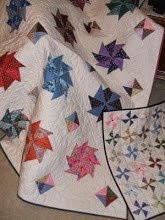
These strip sets were buried in a box in my sewing room closet.  They were leftovers from a quilt that my daughter made many years ago.


It was definitely time to do something with them.  They would be perfect for a lap quilt.  

The strip sets measured 6 1/2" long.  I decided to put them inside cream-colored squares.

The cream squares were cut 4 1/4", then cut in half diagonally.  The center of the long edge of the half square triangle was marked, as was the center of the strip set.  The center marks were matched up to stitch the strips inside the squares.  Once both sides were stitched, the block was pressed and squared up to 4 1/4".

I had seven sets of 6 blocks of the same print combination.  But not all of the strip sets were the same width.  I experimented a bit with the best way to set the blocks together--even tried a pinwheel design.  In the end, to my eye, diagonal rows looked the best. 

The blocks were set 6 across and 7 down.  With six of each strip-pair block, the order of the rows worked out just right!  :)

More buried treasure was found in my closet--enough fabric in my stash for the borders.  The gold fabric was cut 2" wide; the green fabric was cut 4 1/2" wide. 


The finished size of the quilt top is ~34" x 38".   It will be a cozy little lap quilt!


Monday, April 17, 2023

Not Quite Log Cabin

 As you may know by now, I am always on the lookout for quilt designs that will work to make lap quilts and use up my fabric scraps.

At a retreat that I attended last year, there was a basket of $1 patterns.  Looking through it, I found "Garden Window" by Bits 'n Pieces.  The description said "a pieced quilt with applique flowers--make it with quilters quarters".  The background on which the flowers were placed appeared to be a kind of Log Cabin design.

One of my scrap bins contained a stack of "somewhat" coordinated larger pieces of fabric, several of which were wide strips.  These fabrics were perfect for this pattern!

The instructions said to make strip sets of two different sizes and cut those into chunks for the block centers.  The centers were then surrounded by four strips, all cut to the same size.

As I was making the various block parts, I made sure to mix up the placement of the fabrics.  Piecing the blocks was quick and fun.  

When the blocks were set together, no matter which way they were turned, there were no seams to match up!  Easy!!  


The "somewhat" coordinated fabrics are repeated enough so that the resulting quilt top is scrappy, but not too busy (at least to my eye).  Twenty blocks, set 4 x 5, finishes to ~32"x 40". 

Hopefully this colorful quilt will bring joy to its new owner.  :)


Friday, March 17, 2023

A Detour Along the Yellow Brick Road

Whenever I have a set of six coordinated fat quarters, I like to make small quilts from the Yellow Brick Road pattern, by Atkinson Designs.  According to the pattern, six fat quarters will make either a 48" x 48" quilt or one that measures 48" x 57" when borders are added to the pieced blocks.  

For a recent charity lap quilt, I worked with a collection of fat quarters in fall colors.  Following the instructions in the pattern, 20 blocks were made.  When set together, 4 blocks wide x 5 blocks long, the quilt top measured ~36" wide x ~45" long.  

The other lap quilts that I have been making are square, measuring around 36".  None have been larger than 45".  Since I used most of the fabrics in this collection, I did not have enough fabric to make more blocks.  So I removed the last row and finished off one lap quilt.   

I now had 4 leftover blocks.  What could I do with them?  From my stash of leftover fabric scraps, I gathered fabric pieces in similar fall colors.  I scrappy pieced 12 more blocks, trying to use mostly fairly large "chunks" of fabric (so the blocks would look much like the YBR blocks), 

Scrappy piecing the blocks was much more time consuming than making the YBR blocks!  But it was a good use of scraps that I'd collected, and a new lap quilt was "born".  

I've studied the pattern to see how to use it to make only 16 blocks.  It might work to use only 5 fat quarters--the blocks will be pieced the same, just fewer of them and less variety of fabrics.  This is something that I will try in the coming weeks as I continue to make lap quilts for the local VA hospital.  :)  :)  

Friday, February 17, 2023

Trial and Error

Thirty years ago I was making miniature quilts, thinking that by making small quilts, I could try out all kinds of designs faster than making them in standard size.  

Today I am making lap quilts with the same rationale--trying out new ideas while using up fabric scraps, leftovers and stash fabrics.

Several months ago I met a lady who asked if I would help her to make her first quilt.  Happy to start someone on her way to being hooked on quilting, I said "sure".  

During our first meeting, I learned that she does have a sewing background and already owns some of the basic tools.  She showed me the pattern that she wants to make:  "New Shoos" by Jenny Kae Parks, found in the Mar/April 2021 issue of Fons & Porter's Love of Quilting magazine.  I could see why she was attracted to it...the model in the magazine was made from Kaffe Fassett fabrics and was bright and cheery. 

I congratulated her for choosing a fairly simple-to-piece design and a quilt that will turn out not too large.  This quilt will be a great one for her to learn some of the basic techniques--rotary cutting in general, construction of half-square triangles, precise piecing, etc.

Her first "job" was to get the necessary fabrics.  The pattern called for a layer cake for the main fabrics in the blocks and I showed her some ideas on Missouri Star's website.

It would take her a few weeks to gather up her fabrics so I decided to try out the pattern with some fabrics I had on hand--beginning with some 10" squares, charm squares and yardage from a friend, plus pieces from my stash.  The pattern makes 9" finished blocks, so 16 of them will make a lap quilt measuring ~36" square.  

Each block requires two pairs of the same 5" squares to make four identical Half Square Triangle squares.  These are trimmed to 4 1/2" square. The center rectangles are cut 1 1/2" x 4 1/2" and the center square is cut 1 1/2" square. 

After my 5" squares were cut, I marked the diagonal on ALL of them...hadn't yet paired them up. Then I paired them up, stitched both sides of the diagonal line, and cut them apart on the line.  Because I'd marked the line on both squares, I had to be careful about the line on which I was cutting--had to make sure it was between my lines of stitching.  My head must have been somewhere else in cutting one of them--I cut on the line, but this line crossed the lines of stitching!  Now what?  

I still had some of that particular fabric, so after taking the "oops" apart, I pieced together enough fabric to make two 5" squares.  (Just like our quilting foremothers did with their scraps!!!)  I then used those to make more HST squares.  That fabric is a busy enough print that it isn't that noticeable.


This lap quilt was easy to make and mine turned out bright and cheery too!  After making this, I now know exactly how to guide my new quilting friend in making hers.  :)


Monday, January 2, 2023

On Safari in Kenya

My trip to Kenya was called "The Ultimate Safari".  It seemed that every day was some kind of adventure with animals!

On the first day we visited the Giraffe Center, outside Nairobi, where the Rothschild giraffe species is being conserved.  We were able to get up close and personal with these beautiful creatures and feed them special treats. 


On the second day we headed north to the Ol Pejeta Conservancy where we spent the next 3 days.  We stayed in tents and went on safari drives 2 times each day. 

We had to stay in our jeep during the safari drives, but our guide took us as close to the animals as he could. ( And the zoom feature on my camera helped a bit, too!)


Each day we saw a variety of birds, on the drives and also around the campground.  (Deer and baboons roamed the campground, too! )

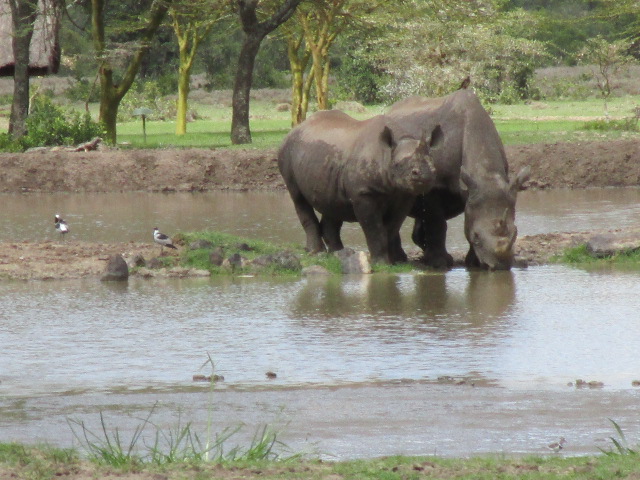
One morning we were able to pet a black rhino...Barak is 27 years old and blind.  He's in his own protected environment and doesn't mind the attention.  

Back to Nairobi, a visit to the David Sheldrick Elephant Orphanage.  Endangered baby elephants are rescued from the wild and brought back to health until they are able to be on their own again.  


And a day trip from Nairobi took us to Lake Naivasha.  We boated near the hippos then walked the grounds to be close to giraffes (Yes, giraffes are my favorites!!!)  :)


This trip had been rescheduled 3 times.  It was definitely worth waiting for, and was truly an amazing adventure!


Wednesday, November 23, 2022

Cutter Quilts

I have been interested in vintage quilts for a very long time.  Along with the vintage blocks that I have been blogging about, my collection includes vintage quilt tops and vintage quilts.  Some are in good shape; others had outlived their usefulness as quilts, but were purchased for a purpose.  Thirty years ago I got caught up in the trend of using old, worn out vintage quilts for clothing, bears, dolls, and other decorative items. That is when I first heard the term "cutter quilts". 

Cutter quilts have damaged areas--holes, spots or worn places--but have areas that are still in good enough condition to use for smaller items.  As with other aspects of quilting, cutter quilts are once again being talked about. All kinds of ideas for using them can be found online.  Just search for "cutter quilt crafts". 

Recently I pulled out some of my cutter quilt scraps to make Christmas ornaments.  


All were made from simple shapes--"three tiered" snowmen;  angel heads on hearts; stockings.

The snowmen are a single layer of the quilt; the edges finished with the buttonhole stitch all around.  After the faces were embroidered, the shapes were stiffened with a 50/50 mixture of Elmer's glue and water.  Once dry, the scarves were tied around their necks and held in place by stitching on a button.  

Both the hearts and stocking are lined--placed RST on the lining fabric; stitched around leaving an opening for turning.  The angel heads are lined circles, hot-glued in place.  Raffia creates their hair.  A bow is tied under their chins; a small charm is stitched right under the bow knot.

The stocking is topped with vintage crochet edging which was basted in place before stitching the stocking piece to the lining.  A bow is tacked to the upper right corner.  

Because I did not know the makers of the cutter quilts that I bought, it was not difficult to cut them up.  These small vintage quilt pieces have found new life in items that will (hopefully) be cherished!


Monday, October 17, 2022

Fugitive Green or Truly Tan???

 I recently sorted through my collection of vintage/antique blocks to determine which blocks I would like to use for my next project.  One block in particular "spoke to me".  

I do not recall where this block came from...purchased or given to me???  From the bits of thread still along the outer edges of the block, it appears that it had once been part of a larger quilt top.  

I like to really study my vintage blocks before I use them to see how they were made and make sure that they are still in good shape.  This block was neatly hand-pieced, using very tiny, even running stitches.  The seam allowances are ~1/8" wide.  The overall block is a little bit wonky, due to the bias edges on the small checked triangles, but still very workable.  The most interesting thing about the way this block was put together is that each red unit is one piece, not two diamonds pieced together!!!  


Searching through my various books of quilt block designs, I could not come up with an exact name for this block.  The 4 corner sections remind me of flowers found in basket blocks...lilies or tulips?  The closest I could come was Sage Bud or a Turkey Tracks Variation (although the center square was much larger in that design.)  I like the way that the Shoo Fly design stands out in the center of this block! 

I can usually tell the age of a block by the colors and fabrics used in it.  This one has me a bit stumped, however.  The check fabric is printed, not woven.  The bright yellowish solid fabric is the cheddar or chrome orange color typically found in quilts of the 1800s.  The red fabric is a thin woven, and (thankfully) the color does not bleed when wet or pressed with a hot iron.  

The solid tan fabric is interesting.  Because this is a variation of a flower block, did the tan fabric start out as green with the color fading over time?  According to Barbara Brackman in Clues in the Calico, p.61: "Synthetic greens appeared around 1875.  The synthetics were often fugitive; like most synthetics, they did not fade true but took on a distinctly brownish cast when exposed to light and washing...Clues to the original shade lie in the...fabric visible inside seams ...where light has not done as much damage."  I have looked closely at the insides of the seams...I see no indication of another color, only tan. 

 "Some believe the red, white and tan* quilt to be a distinct end-of-the-century fashion, but an intentional red, white and tan quilt is likely to be rarer than those that have faded...Occasionally I do see a red, white and tan quilt that was intentionally designed in the color scheme, but most are copies of older quilts, with the copier unaware that the tan in the model was once green."

With that information, I am guessing that this block was made circa 1900.  Because it doesn't really fit with other antique blocks that I have, this block will be the focus of a medallion wall quilt.  Fabrics have been chosen...now to plan the various borders.  


Stay tuned...one of my upcoming blogs will be a show and tell of the quilt tops I've started over the past few months--finished! 

*Floral applique quilts are the ones to which she is most referring here...